New body same soul
The Margrethe bowl is Rosti’s most iconic design – known and loved both in Denmark and around the world. Since its launch in the 1050s, Bernadotte & Bjørn’s original design has remained virtually unchanged for seven decades.
Until now.
THE MARGRETHE BOWL
The new Durostima® material not only lives up to the quality that the Margrethe bowl is known and loved for, but also opens up many new possibilities for use in the modern kitchen by being able to be used in both freezer and microwave. We have kept the bowl’s original and unsurpassed design the same. The new bowl offers the good grip, practical spout and the non-slip ring at the base, and of course, as with all Rosti products, there is a 5 year guarantee.


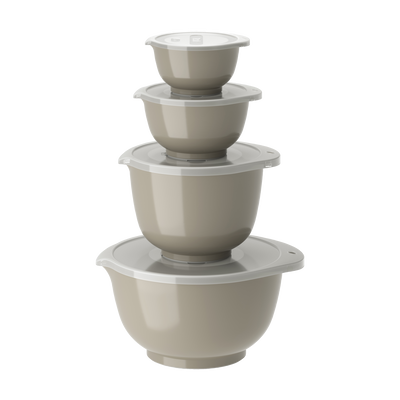


THE MARGRETHE BOWL
QUEEN OF MIXING BOWLS
The Margrethe bowl has been a star in the kitchen for 70 years, appearing on millions of stages around the world. Designed at Sigvard Bernadotte and Acton Bjørn's design studio in Copenhagen, the bowl was named after Queen Margrethe 2 in 1954. The bowl is made to last, and many generations of us know and recognise the Margrethe bowl for its good qualities and many benefits.
The original and unrivalled design has remained unchanged over the years and is characterised by its perfect stackable shape, good grip, practical pouring spout, non-slip base ring, superior scratch resistance and durability.
Margrethe in all shapes


10 COLOURS, 9 SIZES
Eye-catching colours are everywhere. The modern consumer is opting for bold and vibrant shades for the home, both as primary colours and accents. Rosti’s three strong colour novelties signal personality, vitality and energy. Keep an eye out for the deep Beetroot, stunning Lavender and digitally inspired Electric blue – which of course blends in perfectly with the rest of Rosti’s colour palette, carefully composed and selected with an eye for current trends.


The same iconic design
– more options
The Margrethe bowl is now made from Durostima®, making it suitable for use in both the freezer
and the microwave. The familiar design, comfortable grip, pouring spout and non-slip base have
naturally been retained – with a 5-year guarantee.

FROM BACK ROOM TO INTERNATIONAL BUSINESS
Rolf Fahrenholtz and Stig Jørgensen wanted to add a set of mixing bowls to Rosti’s range of products. In 1947 Rosti purchased mixing bowl samples in all imaginable sizes, shapes and materials and asked a large number of housewives about the bowls advantages and shortcomings. The results revealed that housewives wanted a curved bowl that was spacious and yet high enough to allow whipping and stirring without the contents spilling over the sides. The bowl should also have a pouring lip and a good handle for a perfect use.
The next step was to find a designer who could reconcile these requirements with a timeless and functional design. The choice fell on Acton Bjørn and Sigvard Bernadotte’s design studio in Copenhagen, which at the time was one of the few studios in Scandinavia working with industrial design. There wasn’t a great deal of money available for the fee, so not much time was to be spent on the brief, according to the studio’s internal instructions. Fortunately the designers got it right the first time round, and with four colour suggestions for a small extra payment, the task was completed. Rosti now had a bowl that united function, quality and design.
In 1950 the bowl went into production. Some years later, Sigvard Bernadotte wanted to give it a special name. Bernadotte was the son of the Swedish King Gustav VI Adolf, the brother of the Danish Queen Ingrid and thus the uncle of Princess Margrethe. In 1953 the law governing the succession to the Danish throne was changed, and suddenly 13-year-old Margrethe’s name was on everyone’s lips. Bernadotte asked the Danish court for permission to use the princess’s name for the bowl. He received permission to do so, and the next year the bowl was given its name: the Margrethe bowl.
The bowl was subsequently introduced for Christmas 1954 in three sizes, 2, 2.5 and 3 litres in white and pastel colours yellow, blue and green. The collection was expanded throughout the 1960s to include many different sizes and colours and the bowls were fitted with non-slip rings at the base. Lids were also manufactured for all bowl sizes.
The Margrethe bowl has become an award-winning Danish design icon that has been depicted on stamps and which also has been displayed at several design museums worldwide, including the Museum of Modern Art in New York. On a worldwide basis, more than 25 million Margrethe bowls have been sold.